Sunday, November 26, 2006

Missive from the Congo 006

Originally posted on Sun, 26 Nov 2006 20:07:09 +0000 (GMT)

Typical house in most Congolese villages
This week I will briefly cover my trip to what I can only think of as stereotypical Africa. I visited a team site for Military Observers in a small town called Buta. It is about 250 kilometres north of Kisangani. This place is straight out of National Geographic. Almost all the houses are mud huts with thatch roofs. All roads are dirt roads. The chickens, goats, duck and pigs roam freely in the town. You have to be very careful while driving by. You wouldn’t believe how expensive a chicken can become when you run it over.

This town has no electricity, no running water, and no sewage. In fact it has not services at all. There are a few houses that have electricity provided by generators; among them the UN Military Observers house, the diamond dealer’s house and one of the local “hotels”. The UN flies in the diesel required to run the generator but I am lead to understand that a lot of if comes in by bicycle, yes bicycle, from Kisangani which I remind you is over 250 kilometres away on dirt road that are impassable to trucks and cars for much of its length.

Ant hill, or perhaps termites,
in village of Buta
This place is typical of most town and villages in the Congo and much of Africa. It is a niche carved out in the jungle. One interesting feature is the termite mounds that dot the landscape. The one in the picture is about four feet high. Also note the house under construction in the back right corner. Most people are farmers but what that means here is that they walk into the jungle and collect the food that grows naturally (pineapple, papaya, bananas, plantain, palm nuts, etc).

It was a good trip. It made Kisangani seem like a teeming metropolis. Everything is relative.

Have a good week.

John

Monday, November 20, 2006

Missive from the Congo 005

Originally posted on Mon, 20 Nov 2006 06:11:55 +0000 (GMT)

This week’s event was the announcement of the presidential electoral results. The results of the vote were widely expected to be announced on Sunday 19 November. However, because the counting process went more quickly than planned and because false results were being released by various sources, the electoral commission decided to release the results early. The results were announced Wednesday evening. By the time the results were announced, the winner was pretty much already known as partial results were being released as they became available. The interim President, Joseph Kabila, beat Jean-Pierre Bemba 58.05% to 41.95%. A fairly significant victory. Unfortunately, the vote highlighted the polarization of the country with East voting massively for Kabila and the West supporting Bemba. A result that should be familiar to most Canadians.

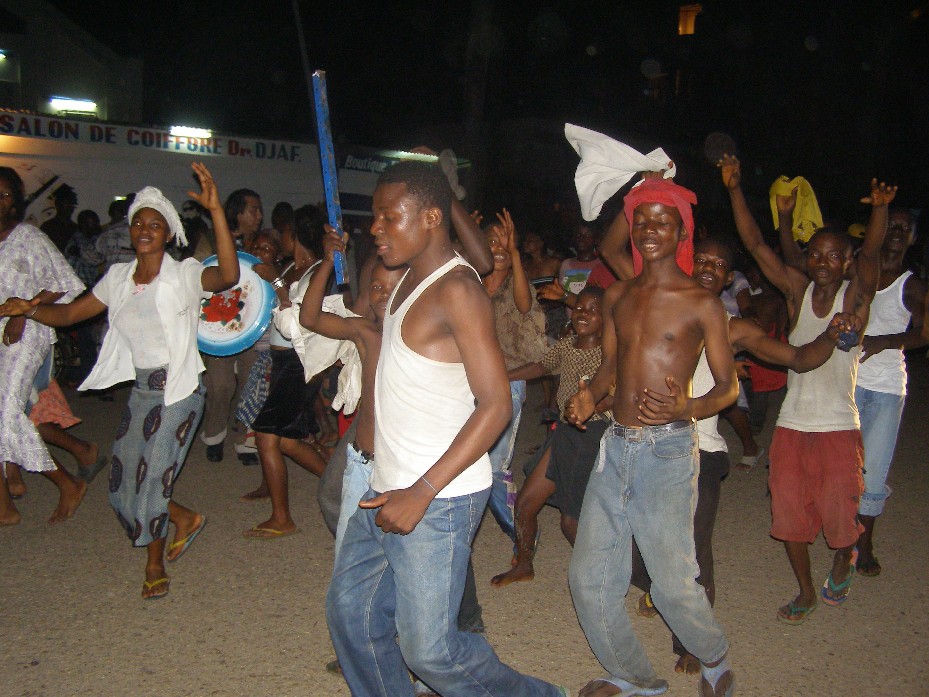
The official announcement resulted in dancing and singing in the streets here in Kisangani, literally. You could hear cheering from all quarters of the city. From my driveway, you can see avenue 30 Juin, which is a main street leading to the downtown core. You could see hundreds of people running up and down the street. People were going by, honking their horns, jumping and shouting and generally celebrating the victory. Remarkably there were no reports of violence or vandalism. There was also, apparently, a lot of nudity. As the evening progressed, people disrobed, a typical occurrence during significant celebrations I’m told. I initially regretted my decision to stay home and out of trouble but was subsequently informed that the bulk of the naked people were men. So apparently I didn’t miss much, or at least I didn’t miss anything of interest to me. The pictures below were taken by on of the Public Information Officers (UN reporters). He is black and as such fit in to the crowd much better than a “mosungu” (white man in Swahili) ever could.


Unfortunately, the losing candidate has rejected the results of the election. He claims there were several “irregularities” and that he actually got 52% of the vote. He intends to contest the results by all available legal means. As long as they stick to legal means they can contest as much as they want. The results will stick as the election was scrupulously fair. But we’ll see. In any event, things are quiet for now and I expect they will stay that way for some time to come.


Have a good week.


John

Sunday, November 12, 2006

Missive from the Congo 004

Originally posted on Sun, 12 Nov 2006 09:38:07 +0000 (GMT)
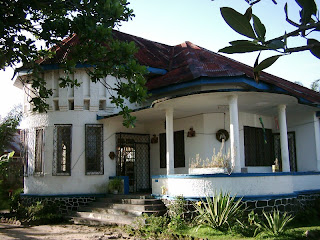
Canada House Kisangani
Today I will cover life at Canada House. I share a house in Kisangani with the two other Canadians posted here. This particular house has been rented by the Canadian contingent for at least four years.

It is considered to be one of the better houses here in town though everything is relative. I would not consider living in this house back in Canada. It is definitely a “fixer-upper”. Having said that, you can see that the house has potential and must have been very nice 20-30 years ago. It sits on a fairly large lot just off the main street. It is a three bedroom house with a large living room/dining room though the kitchen is rather small. The most impressive thing about the house is the height of the ceilings in the main rooms. They must be at least 20 feet high. However, the maintenance on the building has been haphazard over the years and nothing is ever done really well so patches to the wall don’t match the color of the wall itself. You walk directly on the cement floor that hasn’t been re-painted in years. There has been water damage. The leak was fixed but not the damaged to the plaster or ceiling tiles. The house is just kind of rundown. On the positive side, it is kept clean and everything generally works.
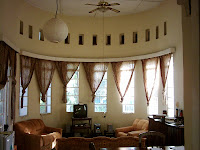
Living room at Canada House
Life in Canada House is a cross between living in an old farm house and being in a hotel. The farm house part comes from the fact that water and electricity are not always dependable. The electrical service is not bad but it does cut out occasionally. It also operates on a three phase system which I don’t quite understand but the impact is that when they switch phases we have to go to the main electrical panel outside and make some adjustments. If there is an electrical engineer among you, perhaps you can explain to me how these phases work. The power is also not very “clean”, that is to say there are variations in voltage that can damage electronic components so we have several voltage regulators for the more sensitive equipment. We also have a backup generator but it has been acting up lately so we have to get that fixed. Water is also an issue. The city water only works a few hours a day. So we have a cistern that fills up from the city supply and we have an electric pump that supplies the house from the cistern. The pump has also been acting up lately. So if you’re in the shower when power goes out…Finally, there are the chickens. We have three of them and a rooster. They have a henhouse in the back yard but have the run of the yard during the day. We keep them to have a good supply of fresh eggs. The quality is better than those available in the market because they are well fed. We also have a banana tree.
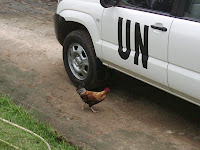

The Chicks at Canada House
Living here is also like being in a hotel. We have staff who do many things we would normally do ourselves at home. First there is the maid Charlotte. She cleans the house, washes the dishes, and washes our clothes (by hand in a big tub). She works very hard and keeps us afloat. SalĂ© is our grounds keeper. He tends to the chickens, the small garden and does the yard work. As you imagine, things grow very well around here so the yard needs lots of attention. I don’t see how we would manage without them. We simply wouldn’t have time to get everything done. Finally, there are the security guards. They man the front gate and generally keep and eye on things. They are necessary for security from thieves and fires. So like at a hotel, you are never alone except in your room. The staff work hard. We pay them very well by local standards but for us it’s a pittance. Less than a night out for supper in Ottawa. It is one advantage to life in the developing world.
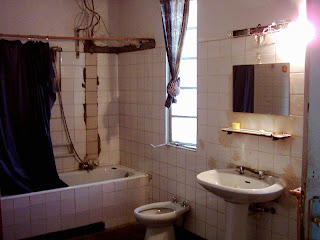

Bathroom at Canada House
Finally, I have to mention the church next door. There are regular services held most days it seems. The service is in French and Lingaga (a local language). The priest and translator both use a public address system that is turned way up. When they talk it sounds like they are yelling at each other, loudly. There is also some off-key singing and music. Sunday mornings are not a quiet affair that is for sure. We could have worst neighbours I suppose.


That is all for this week. The electoral results will be announced next Sunday. Keep your fingers crossed.

John

Saturday, November 4, 2006

Missive from the Congo 003

Originally posted on 04 Nov 2006 19:33:56 +0000 (GMT)

Potholes on a main artery
in Kisangani
As promised last week, this week’s missive with cover the issue of getting around Kisangani. Kisangani is a town with a population of approximately somewhere between 650,000 and 750,000 people. It is bordered on the south side by the Congo River and on the north-west by the Tchopo River. It is relatively compact town covering perhaps 40 square kilometres. First the roads. As mentioned in my first missive, paved roads are the exception. There are only a few main roads that are paved and that was probably 20-30 years ago. There are sections that are heavily cratered (the holes are too big to be potholes). The photo is of one section in the heart of downtown. Needless to say there is a lot of bobbing and weaving by all parties to try and have as smooth a ride as possible. It’s a challenge especially at night. The secondary roads are much worse. Some are impassable to cars and truck.

Toleka with passenger
The main form of transportation in Kisangani is the bicycle, with motorcycles coming second place. There is no public transit as we would know it. No buses or taxis. There are, however, tolekas. These are bicycles that are modified and reinforced to carry a passenger. They are everywhere. They move people from point to point in town and even over fairly long distances such as the airport which is about 15 km out of town. The cost is a pittance. From Canada House to the HQ, which is a 2 km ride, would cost approximately 25 cents. Everybody uses them, often while carrying bags, groceries, children, or just about anything else. The most surprising site is to see the women in dresses riding side-saddle.


Riding side-saddle on a toleka
Finally, crossing the Congo River. There is no bridge and the ferry broke down years ago. So you cross the river in a pirogue (canoe). They appear to be quite large and filled to the gunwales with people and stuff. So they are heavily laden. Further the current is quite fast so they drift downstream quite a bit while crossing. It’s kind of funny actually but it must be extremely hard work. I am heading back to Kinshasa this week for my arrival training.

Crossing the Congo River


Have a good week.
John

Monday, October 30, 2006

Missive from the Congo 002

Originally posted Mon, 30 Oct 2006 05:12:14 +0000 (GMT)

The last page of the ballot for the
provincial assembly.
It was Election Day in the Congo on Sunday 29 October. The election was the runoff for the presidency between the interim President Joseph Kabila and the vice-President Jean-Pierre Bemba. I personally wouldn't want to vote for either candidate, one of whom has been indicted by the World Court for crimes against humanity for atrocities committed during the war. Unfortunately those are the choices facing the Congolese people. The electors also had to choose provincial members of parliament. The ballot for the provincial elections was crazy-huge. There were 279 candidates. The ballot was seven pages long. It included the name of the candidate, the logo of the party and a picture because of the low rate of literacy. People were often simply urged to vote for candidate number 88, or something similar.

The day was very anti-climatic. We had been building up for this day for weeks putting on a "Show of Force" last Thursday to convince local trouble makers that the UN had the wherewithal to deal with trouble if it showed up. Nonetheless there were no indicators of trouble on the horizon. Everybody seemed eager to get to the polls.

My day started out with a squabble among the UN civilians as to who was in charge. I stayed out of it. I know exactly who my boss is. That's one of the advantages of being in uniform; the chain of command is usually crystal clear.

A voter examining the ballot.
There were very few incidents reported in our area of operation. Those that were reported were minor in scope and negligible in impact. The fear was that things might get out of hand in Kinshasa (the capital) though because they voted overwhelmingly for the underdog in the first round and might not accept defeat well. Fortunately for public order, there were torrential rains in Kinshasa Sunday, which undoubtedly kept the crowds to a minimum. Some polling stations opened late because the staff had trouble getting in to work. Others were flooded, at least partially, and had to rescue the voting material before opening. In the end the voter turnout was low across the country (40-60%) but still compared well to US presidential elections and very well to Canadian municipal or school board elections.

Polling station on the outskirts of Kisangani
The next tense moment will be the announcement of the provisional results in three weeks. Until then, things should be quiet.

Next week, getting around in Kinsangani.

Tuesday, October 24, 2006

Missive from the Congo 001

Originally posted 24 Oct 2006 19:58:38 +0000 (GMT)

Hello all. This is my first missive from the Congo. It has been a whirlwind of change for the first six days. I left Ottawa last Wednesday and after nearly 20 hours of traveling, arrived in Kinshasa (The capital). The airport was something else. Everybody wants to help with your luggage. They won't take no for an answer and obviously want to be paid for their "help", even if all they did was place their hand on the pile of luggage while you pushed the cart. Fortunately we had a local UN employee to bark at them and help maintain some semblance of order.

The drive in from the airport is something else. Imagine a farmers market/flea market but without tables, on a dirt road… for 15 kilometers. Everybody is trying to sell something, a lot of it junk. There is no public transportation system so people use a sort of communal taxi, such as they use in Mexico. Except that here the vehicles are battered rust buckets, usually with no windows and with people hanging out the sides and back. The driving is manic. It makes the Metropolitan at rush hour in Montreal seem like an orderly and sedate Sunday drive. They pass on the left and right. There are tons of bikes that weave in and out of traffic and there are no traffic signals.

After one day in Kinshasa I move on to Kisangani which is a provincial capital I will be staying at for the remainder of the tour. Kisangani is much less hectic though the drivers are just as bad and the roads are much worse. There are potholes everywhere on the main roads. The secondary roads don’t have potholes because they are not paved. They have ruts and mud holes. They make the road to my parent’s cottage look like a four lane highway. More on that in another missive.


The last three days have been devoted to the handover. I have been so inundated with information I feel like my head will explode. I liken it to drinking from a fire hose. The staff is multinational. There are only two people from the same country. The other 25 or so persons are all from different countries. One of the most difficult things so far has been to try and get use to the multitude of accents and remember who to speak French to, and who to speak English to.


Anyways, it is getting late for I will sign off for now. Talk to you next week.
John