Thursday, April 28, 2011

Missive from the Congo 020

This week’s missive is about Rwanda. Last weekend being a long weekend (Easter), five of us drove to Kigali, Rwanda for a change of scenery. In this missive I will discuss some of the similarities and differences between Rwanda and the Congo.

Someone, I don’t remember who, when referring to Rwanda, called it the “Switzerland of Africa”. The metaphor is apt. Rwanda is tiny. It has a total area of approximately 25 million square kilometres or about half the size of Nova Scotia. As with Switzerland, Rwanda’s neighbours are much larger. In comparison the Congo is almost 100 times larger than Rwanda. Rwanda is also very hilly. It is referred to in French as “le pays des milles collines”. The entire west and center of the country is mountains. It took three hours to drive from Goma to Kigali and the entire time was spent climbing and descending mountain passes. As an indication of how much up, down and around the road does, the distance from Goma to Kigali as the crow flies is 106 km but the actual road distance is 155 km. That’s a 50% premium. Needless to say it was an exciting drive in darkness.
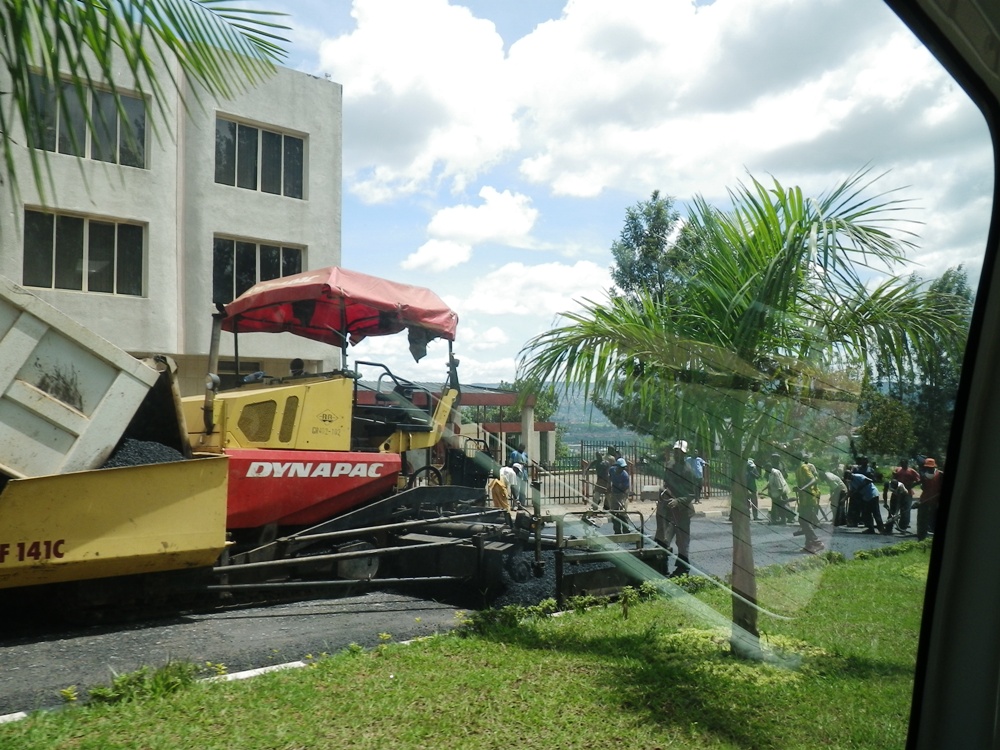

New pavement in central Kigali

Having said that, one of the first things you notice the relative quality of the roads. The entire road between Gisenyi (the town on the Rwandan side of the border) and Kigali is paved, as are all the major roads in Kigali. Moreover the pavement is not leftover stuff from colonial days like much of the pavement in the Congo. It’s relatively recent and in good condition. In fact they were laying some fresh pavement while were there. The road east of Kigali to Akagera National Park was also well paved, at least up to the town just outside the park. Now to be fair, the side streets in Kigali weren’t any better than those in Kinshasa. Nonetheless there is a very significant contrast between Kinshasa and Kigali.


The means used to get around town in either city are pretty similar. Generally that involves collective taxis (mini buses), motorcycles and bicycles. The main difference though is quality. The vehicles in Kigali appear to be in good order. The relatively good condition of the roads helps keep them that way I’m sure. There are also a great number of motorbikes, as with Goma. Again the difference is quality. The motorbike taxis in Kigali appear to be regulated. The drivers have jackets with some kind of numbering scheme. All drivers have helmets and a spare helmet for the passenger. No such luxuries in Goma. There were also some “normal” taxis in Kigali. Again no such luxury in Goma and I don’t remember seeing any in Kinshasa.


Public service announcement

Finally, the thing that struck me the most is the language. Rwanda is a former German colony that was part of what was known as German East Africa. Following the end of WWI, the League of Nations declared Rwanda a mandate territory under the control of Belgium. As such, Rwanda became a mostly French speaking country. However, there is now a decidedly English bent to the country. The clerks, wait staff and others seemed determined to speak English instead of French. Public service announcements were in both Swahili (I assume) and English. I saw relatively few French signs, and those seemed relatively older. One of my fellow travelers, who has worked with a Dutch non-governmental organisation, said there was conscious public policy decision to shift to English. English is now taught in schools to a greater degree than French and as mentioned above many of the public service messages are in English as opposed to French. It is apparently intended as a deliberate break from the past.


All in all, Rwanda was a rather interesting study in contrasts. I don’t know how Rwanda and the Congo compared before the Rwandan genocide and subsequent African wars but they have surely drifted apart now.

Wednesday, April 20, 2011

Missives from the Congo 019

So I've been in Goma for a little less than a week though I've already spent two nights out of town in Bukavu which is at the other end of lake Kivu. Like the other major cities I've been to (Kinshasa, Kisangani, Kindu and now Bukavu) Goma has it's own personality. The first thing you notice is the weather. Goma is 1,500 m above sea level in the mountains of the central African plateau. It is cool here. The average daily high in 25 degrees and the low is about 15 degrees. So perfect weather in my books. There is no air conditioning at the house and you need a blanket on the bed. The altitude also means many fewer mosquitoes though we still sleep under the bug nets.


The other significant difference is the roads. The roads in Goma are atrocious. The is largely because of Nyiragongo, the volcano just 20 kilometers out of town. The entire town is built on more or less recent lava flows. The flows are hard, irregular and jagged. It is very difficult to create a smooth road surface on the lava flows. They cover the base with generous amounts of crushed stone and stone dust but some of it invariably washes away with the rains, leaving potholes with jagged lava rock sticking out. It's tough on the suspension and worse on the tires.


The availability of food and restaurants is much greater in Goma than in Kisangani four years ago. It rivals Kinshasa but at a lesser cost. More on this in a later missive.


Finally, Goma has a more eclectic mix of vehicles on the road. There are many more cars than in Kisangani but not the crush of vehicles you see in Kinshasa. There are also many motor bikes and, unique to the Goma area, chickadoos. These are like oversized wooden bikes mainly used to carry stuff around. Driving is ever a challenge in the Congo. Goma is no different in that respect.


All and all Goma is living up to its' reputation as the best place to be in the Congo.

Thursday, April 14, 2011

Missive from the Congo 018

Boulevard 30 Juin, Kinshasa
So this is my last day in Kinshasa for quite a while. I take off to Goma tomorrow AM so my impressions of Goma will have to wait until next week. So this week I’ll talk about life in Kinshasa a little more. Last week I said that time seemed to have passed Kinshasa by. While much have remained unchanged in the last four years, after being for ten days or so, I have to admit that there has been some changes. The most noticeable change is Boulevard du 30 Juin. This is the main boulevard in Kinshasa. While is it was one of the better roads fours years ago, it has been rehabilitated with assistance from China. New pavement. New drainage. And new lightposts. It’s as good as any road in Ottawa, actually better than most. There is also construction along an extension of 30 Juin to widen the street and improve drainage.


Collective taxi
Another, more subtle change is in the number of what were referred to by the Canadians four years ago as “spidermen”. These are the guys, and they are invariably men, who hang off the back or sides of the collectives taxis. Four years ago they were everywhere, often four or five to a vehicle. Now I’ve seen a few but they are few and far behind. I mentioned the “spidermen” to my tour guide while on safari in Kenya four years ago. He said that the same thing occurred in Kenya until the government cracked down on this patently dangerous practice. I don’t know if that is the explanation for the change or something else but it is progress of sorts.


One other thing I noticed is that there seems to be more fitness clubs. Four years ago I was only aware of two places; the Grand Hotel and Elais. Now, there are at least two others and perhaps more. There are also bank machines. In fact the banking system has developed to the point there UN staff posted to major cities are now have their mission subsistence allowance paid to a local bank.


So I guess Kinshasa has seen some progress. It still has a very long way to go to be a liveable city for more than an very small minority but some is better than none.

Wednesday, April 6, 2011

Missive from the Congo 017

So here we go with the first missive of this my second tour to the Democratic Republic of Congo. The trip over was the usual very long day. The icing on the cake, after the seven hour flight from Paris, was the three hour drive to Canada House. This is a drive that normally takes less than one hour. However there was a rugby match which clogged up the only route from the airport tight. A one point there was eight lanes of traffic on a two lane road. The main cause was oncoming traffic turning left at an unregulated intersection. Some things never change.


In fact change does not seem to have troubled Kinshasa too much these last four years. I didn’t spend all that much time in Kinshasa last time but there is precious that appears to have changed. There are still vendors on the sides of the roads selling, watches, purses, clocks, maps, office furniture, safes, etc. In fact, if there is a market for it, you can probably buy it on the streets here.


Canada House "Blue"
One thing that has changed is Canada House. The size of the contingent in Kinshasa increased by two persons so Canada House had to change. The Canadians here currently rent two three story condos in a small three building compound. There are five bedrooms in each house. I am currently in one of the spare rooms on the third floor, at the top of a very narrow and steep spiral staircase, with steps whose spacing is ever so slightly out of whack. It’s clearly a sobriety test.

The introduction course to the mission starts Wednesday and runs for five and a half days. In it I will get to cover most everything I covered previously at least three times with the possible exception of the course on sexually transmitted diseases. They didn’t cover the use of condoms in Kingston. I believe the highlight of this week will be the English language proficiency test. Can’t wait.
Stair to the third floor
Finally, as many of you know there was an unfortunate airplane craft on Monday. I won’t speculate on the cause of the crash. The investigation will reveal that in due course. I will ask though that, should something like this happen again, you not panic or get anxious. There are tens of thousands of UN and UN-affiliated personnel here. The odds that I would be involved in any specific accident are remote at best. It is also likely that I would be unaware of the accident for hours or days and may not have ready access to the internet to post something to Facebook. So relax. Your stress won’t change a thing except make you feel anxious and lose your appetite. There’s no need for that.


That’s it for this week. Next week, first impressions of Goma.

Wednesday, April 25, 2007

Missive from Paris

Originally posted on Wed, 25 Apr 2007 04:38:15 +0000

Well, it's all over but the partying. I am writing this missive from the posh confines of the business class lounge in Charles de Gaulle airport in Paris. We left the Congo last night and flew overnight to Paris. We arrive in Ottawa this afternoon.

A few final thoughts about the last six months. First, I don't know to what extent I personally made a contribution to the Mission or to the Congo in general. The problems are so large that no one person can deal with them. That being said, I do feel that I contributed in some small measure to improving the lives of the average Congolese. Even small changes can be significant at this stage. But there is still a long way to go.

Personally, the experience was everything I hoped for and more. The work was challenging and rewarding. The staff who worked for me were/are excellent (I got lucky in that respect). I met some fascinating people and made some good friends. It is an experience I will never forget. I am happy to have had this opportunity. I would do it again were I given the chance.

Finally, I would like to thank all of you for your support, and your support to Chantal and the boys. Your e-mails always livened up my mornings. I have a few weeks of leave before going back to work. That will give me the chance to organise the hundreds of pictures I have taken. I'll let you know when show and tell night is.

See you all soon.

John

Thursday, March 29, 2007

Missive from the Congo 016

Originally posted on Thu, 29 Mar 2007 21:06:59 +0200

For this week’s missive I will talk about trash collection. Another topic that will have you hanging on the edge of your seats I know. As you can well imagine, given the breakdown of most municipal services as a result of the years of war, there is no regular garbage pick-up. This, of course, is a problem. We generate a fair bit of garbage, as those of you who have to haul it to the curb on a weekly basis know full well. In addition, there is no formal recycling system either, which just compounds the problem of trash. So what do you do? Well, I can honestly say that I don’t know exactly what the average Congolese family does. However, given that they don’t buy much packaged food, or consumer goods in general, they probably don’t generate that much waste. At Canada house we have a trash pit/pile at the rear of the property. We have it emptied every six months or so at a cost of $50 USD. I’m not sure exactly where the trash goes, except away from our place.

Canada House garbage pit
As you can see, it’s time to empty the pit. Our property manager/go to guy contacted the trash haulers but was told that they didn’t have any fuel therefore they wouldn’t be doing any pick ups. Apparently it didn’t dawn on them that if they did the work they would get paid and hence have money for fuel. But anyway. So our trash will be taken away using oversized wheelbarrows that are used in the Congo move just about anything, up to and including the living room furniture.

The other thing that happens is that there is a very active re-use market. When you have nothing, even scraps for something are worthwhile keeping. For example, MONUC gives us drinking water in 1.5 litre bottles. MONUC doesn’t take the bottles back so there is a very brisk trade in used MONUC water bottles. My cleaning lady tells me that you can sell them in the market for about 40 Congolese Francs a piece. The further you go out of town, the greater the price. The same thing happens with the glass jars and many other items.

Garbage fire
Finally, what doesn’t get reused or hauled away in so form or other gets burned. At any given time of days there are dozens of little fires burning around town; in people’s yards, on the side of the road, in the back alley, or just about anywhere. Sometimes the smell is atrocious but I guess it’s better than letting things rot.

We get newspapers and magazines from Canada as a welfare support programme. Naturally we only keep so many on hand. A number of Congolese have asked me to give them used magazines. They claim to be avid readers. It may be true to an extent but I suspect they re-sell them. Or use them to wallpaper the mud huts. I don’t know. I just know we don’t put them in the trash.

In any event, I don’t have much of a moral for this story. Just, perhaps, to appreciate the garbage men a little more. You’ll miss them when they’re gone.

John

Tuesday, March 20, 2007

Missive from the Congo 015

Originally posted on Tue, 20 Mar 2007 20:39:58 +0200
Traffic police in Kisangani
A number of you have remarked on the fact that I haven’t send out a missive since the 12th of February. You have uniformly been generous in suggesting that it is no doubt because of the workload and other such factors. Well, the truth is I have gotten lazy… and I sort of ran out of ideas to write about. However, I’m all better now. So today I will write about traffic control measures. Doesn’t sound like much of a subject until you’re in a place where the rules a very different.

First of all, in Kisangani, there are no traffic lights. Well, that’s not quite true. There are a few but they all look like the one in the attached picture. I can’t imagine that they have worked in the last ten years at least. So it’s “who dares, wins” when you get to an intersection. Might, or size, also makes right. Since there is much more bicycle traffic than anything else, and I drive a big SUV, I usually don’t have to yield much. There is progress though on this front. I was in Kinshasa a few weeks ago and they had one traffic light working.

One of the few traffic lights
in Kisangani. Obviously
it's not working
Another important difference from North American standards is when the right of way is in doubt, the Congolese will flash their lights. This is not an indication that you can go. In fact it is the reverse. If you intend to take the right of way you either honk your horn or flash your lights. Either way it means get out of my way.

Now the city is not completely without traffic control measures. At the exit to the UN installations, there are little huts within which sit local policemen. They will signal you whether or not it is safe to exit. They have green “pass” signs and red “stop” signs. Little human traffic lights. There is also a traffic police booth on the main intersection in town. If the police officer is placed sideways to you, you can go. If he is facing you (or has his back to you), you have to wait.

The traffic police at the exit to the HQ
Then there are the traffic circles. There are quite a few of them and they operate on the French principle instead of the English. That is to say that traffic entering the circle has priority over the traffic already in the circle. It’s a recipe for disaster if you ask me, or at least traffic headaches, since any amount of traffic can enter the traffic circle but you can’t leave it as easily. It’s not too bad in Kisangani as we don’t have that much traffic but you do have to be aware that the car approaching on the right won’t stop for you.

In any event, that is it for today. I have four more missives to write after this one. D-38 and counting.

John